
How AI Vending Machines Work
AI vending machines look simple from the outside — and from the customer’s perspective, they are. But the technology running underneath that simplicity is a significant leap forward from anything the vending industry has done before. Here’s a plain-language breakdown of how the whole thing works, from the customer’s first tap to the operator’s dashboard — and why SandStar’s approach is genuinely different from most of what’s on the market.
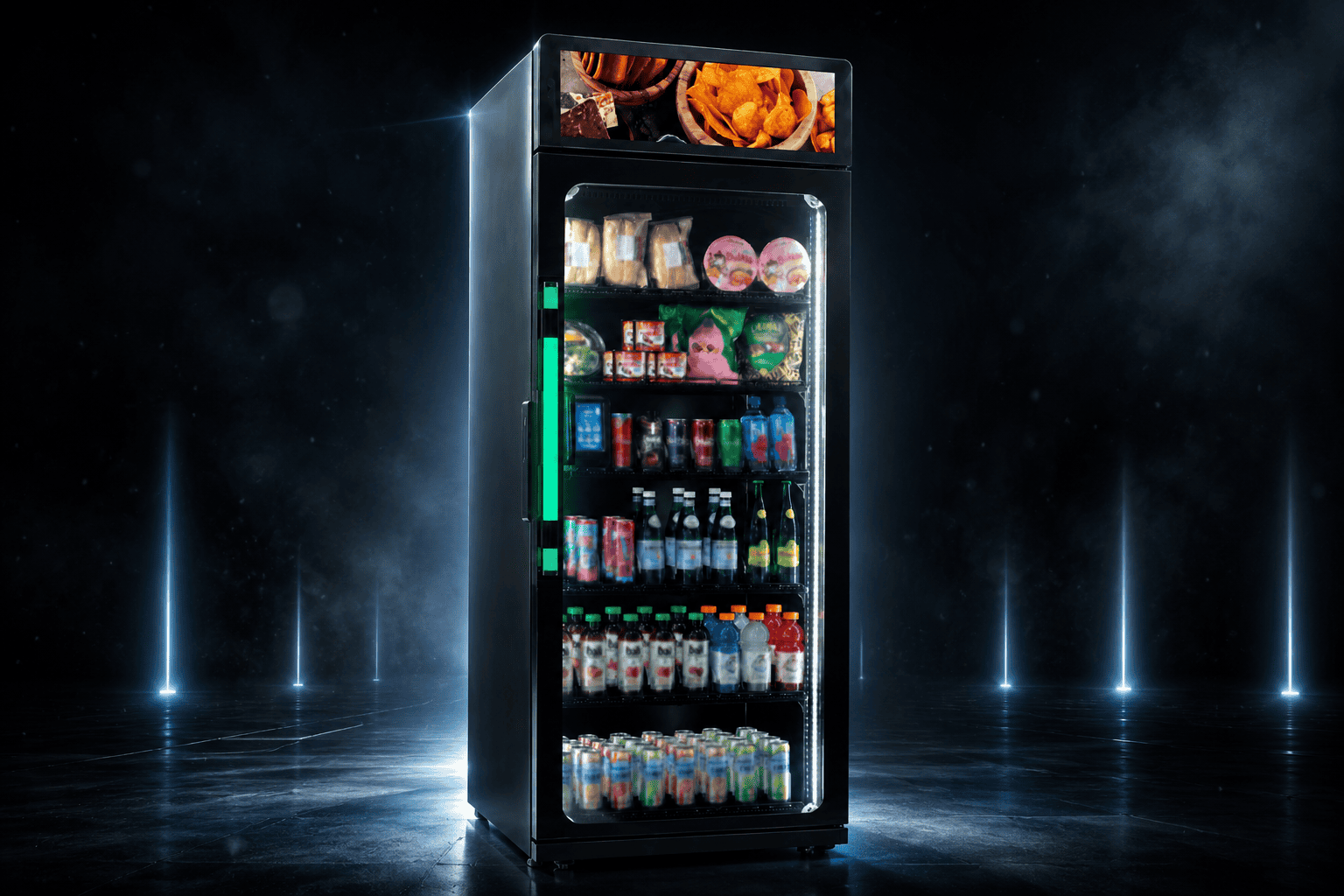
What shoppers experience
The customer walks up to the machine and taps a credit card, Apple Pay, or Google Wallet against the payment terminal on the front of the unit. No app to download. No account to create. No PIN. Once the payment is authorized, the cooler unlocks automatically. On the VRK, the interactive LED handle turns green, and on both the SRK and VRK, a built-in voice assistant welcomes the customer and prompts them to begin shopping.
The customer opens the door and shops just as they would at a convenience store. Products are displayed on open, adjustable shelving, allowing them to pick up an item, read the label, compare products, or put something back. It doesn’t matter where an item is returned — the AI cameras recognize products throughout the cooler, so customers can shop naturally without worrying about placing items back in a specific location.
When the customer closes the door, the AI has already identified the items selected and displays an itemized shopping cart on the payment screen. This allows the customer to see exactly what was recognized before the transaction is finalized — a major advantage over many AI coolers that provide no purchase summary leaving customers confused. If the customer believes an item was recognized incorrectly, they have a brief opportunity to dispute the transaction. The transaction is then flagged for the operator to review using the recorded transaction data and camera footage.
Once the transaction is finalized, the customer is on their way. A digital receipt option is provided, and the entire shopping experience typically takes less than 30 seconds — with most customers completing their purchase in under 10 seconds once the door is opened.
Real AI — not a remote monitoring room
The recognition system in SandStar AI smart coolers uses true AI-powered computer vision. While some competing AI coolers rely on human transaction review behind the scenes to verify purchases, presenting serious privacy compliance concerns, SandStar’s self-learning AI recognizes products automatically and continuously improves with every transaction. Here’s why that matters.
Computer vision identifies products by sight. Cameras inside the unit recognize each item based on its shape, size, color, packaging, and other visual characteristics. No scanning. No tagging. Products can be stocked naturally anywhere in the cooler, and customers can return an item to any shelf or position — the AI automatically recognizes it wherever it is.
SandStar’s system is trained on over 1.5 million SKUs and achieves 99%+ recognition accuracy.
Not all “AI” smart coolers are created equal. A number of machines manufactured overseas — particularly in Asia — rely on rooms full of remote human reviewers who manually verify each transaction after the fact. The AI branding is real, but the recognition isn’t fully automated. Someone overseas is watching and approving your transactions. This has presented serious privacy concerns across Europe and North America.
SandStar’s system uses genuine embedded AI algorithms to handle recognition autonomously, on the machine, without remote human review of individual purchases. That’s a meaningful difference in both privacy and operational integrity.
What happens when a customer puts something back?
This is one of the most common questions about AI smart coolers, and the answer is one of the most impressive things about the technology.
If a customer picks up a product and returns it to the shelf before closing the door, the AI detects that in real time and removes the item from the running total immediately. The customer is never charged for something they put back. This isn’t reviewed after the fact — it’s calculated live, while the door is still open. When the door closes, the charge reflects exactly and only what the customer kept.
This flexibility is a significant advantage over many other smart coolers, which expect products to be returned to their assigned location within the planogram for recognition to work correctly. With SandStar’s true AI-powered computer vision, customers can return an item to virtually any location in the cooler, and the system still recognizes it automatically — creating a more natural shopping experience while reducing recognition errors.
Two features that matter
Beyond the customer transaction, SandStar AI smart coolers include two safety and security features that protect both the operator’s investment and the integrity of the products inside.
If the internal temperature rises above a safe threshold — the point at which perishable products like food and dairy could spoil — the machine automatically locks. It cannot be opened again until the temperature is restored to a safe level. This forces an operator check-in to verify product integrity before the machine goes back into service.
For operators stocking fresh food, beverages, or dairy products, this isn’t a minor convenience feature — it’s liability protection. A machine that silently sells warm or spoiled product creates customer complaints, refund requests, and reputational damage. The health timer eliminates that scenario by taking the decision out of anyone’s hands automatically.
The SandStar coolers run four AI cameras covering the interior simultaneously. If any of those cameras is physically blocked — deliberately covered or obstructed — the system responds immediately and visibly. A built-in voice alert is triggered to draw attention to the obstruction. On the VRK, the interactive LED handle turns red, and the 26-inch digital display presents a visual warning message. The response is designed to deter tampering before a theft occurs, rather than simply recording the event afterward.
By combining multi-angle AI cameras with audible and visual alerts, the system is designed to discourage tampering before it results in shrinkage — not simply record it after the fact.
What you manage
Every AI smart cooler connects to a cloud management dashboard. From any browser or mobile device, you can see:
The system tracks what’s been removed and what remains. You can see inventory levels across all your machines from a single dashboard without visiting a single location.
Set threshold levels for each product. When a product drops below that threshold, you get an alert. No more arriving to a location to find a machine half-empty.
Every transaction is logged with product, quantity, time, and location. You can see what’s selling, when it sells, and how each location performs relative to others.
Adjust pricing on any product at any machine without an on-site visit. If a product is moving fast at one location, you can test a price adjustment remotely in minutes.
Full records of every sale, including dispute resolution data if a customer ever questions a charge.
How AI vending compares to traditional vending
| Traditional vending | AI smart cooler | |
|---|---|---|
| Customer interaction | Select code, press buttons | Tap, grab, go |
| Product selection | Limited to what fits in coils/slots | Any product that fits on a shelf |
| Recognition method | Mechanical delivery | Computer vision |
| Recognition verification | N/A | Embedded AI algorithms |
| Impulse purchase potential | Low | High |
| Revenue vs. comparable location | Baseline | 50–100% higher |
| Mechanical failure risk | High (motors, coils, elevators) | Minimal |
| Temperature protection | Standard refrigeration controls | Automatic health timer lock if temperature exceeds limits |
| Theft deterrence | Standard cabinet locks | 4-camera system with active voice and visual theft deterrence |
| Operator visibility | VMS platform (cashless reader dependent) | Integrated VMS plus dedicated OPS mobile app |